Ushev recomposes and triturates with great aesthetic vigor and panache Eisenstein's The Old and the New, giving this title a new historical dimension, the Old becoming the USSR and the New Putin's Russia.
A corrupted computer system explains its reasoning for taking over control of the world.
Great darkness and dominant light.
Inside a block of flats, a young woman decides to act about something concerning her for a long time.
This work is a consideration of the vision expressed by "dot".
The film explores a young man's intimate relationship with the Internet. While the absence of a father figure has left him searching for answers, he finds an unexpected mentor in Google. From learning everyday tasks like shaving to discovering deeper knowledge, the algorithm becomes much more than a simple search engine, blurring the boundaries between real and virtual.
The animation, music, and optical printing of Kitsch in Synch was produced by Beckett and the students in two classes he was teaching at CalArts. Although a group project, it is clear that Beckett was the director. The playful, catchy soundtrack is used to create a cycle of building tension and release. The brightly colored shapes create approximate symmetrical formations and become more densely layered, with glimpses of iconographic objects and even live footage near the end. Preserved by the Academy Film Archive, in partnership with the iotaCenter, in 2007.
The surreal, experimental story of an unseen serial killer.
Costante dies and leaves his wife Torella his computer discovery. Torella entrusts the disk to her husband’s friend Gervasio, a lazy man scorned by his family. Twenty years later, Torella tries to get back the disk but Gervasio, who has become rich thanks to the discovery, agrees to go to court over it and comes away the winner. He therefore summons divine misfortune: he loses his third son, suffocated by wealth; kills his wife in a blind rage; and is executed by his first-born son who, after a violent panic attack and reckoning with his conscience, chooses life.
A man is sick and he doesn’t show himself. Three people don’t go to visit him and they show themselves.
In the land of the slides, three handicapped plot against people with two legs.
A man closes the same doors that Kafka opened.
Moses searches for history into palletes.
Under the relentless sun, a killer stalks through the mountains, where the innocence of a young couple becomes prey. With no shadows to hide their fate, the hunt is a macabre game in broad daylight, where fear is not hidden in the darkness, but burns with the rawness of the unperturbed noon.
By Clea T. Waite with music by Mario-Erik Paoli. Originally shot on super 8. From the MWF catalog: "A study of the female nude, and transformation of movement and light under water. These "living sculptures" enact an interpretation of the triple goddess myths in black & white."
STEINA: “My background is in music. For me, it is the sound that leads me into the image. Every image has its own sound and in it I attempt to capture something flowing and living. I apply the same principle to art as to playing the violin: with the same attitude of continuous practice, the same concept of composition.
Robert Estragon has worked his way to the top of the food chain as a doctor in the city, but it has driven him to self-imposed delusion. Here, we listen as he sits and projects himself onto the mad world he observes. It all comes to a head when Willie Krapp, a young colleague, invades this world, hoping to teach Robert that it was wrong to let his own daughter die in the operating room.
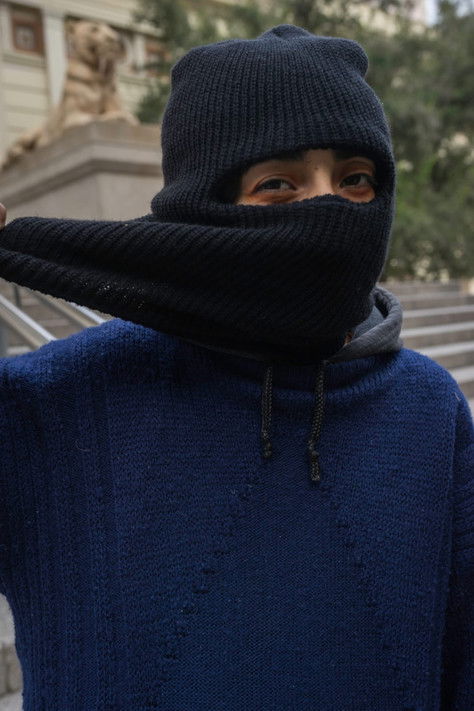
The story of a girl, after a breakup, removing her makeup and finding herself again in grief. About life, places, being yourself wherever you are, in love, and not losing yourself, moving through things. "Balaclava Quemado is about not ceasing to be yourself no matter what situation you find yourself in; with or without wearing it, it's the strength to keep going, it's a bit of a symbol of taking the freedom that one can and carries within." Daniela.