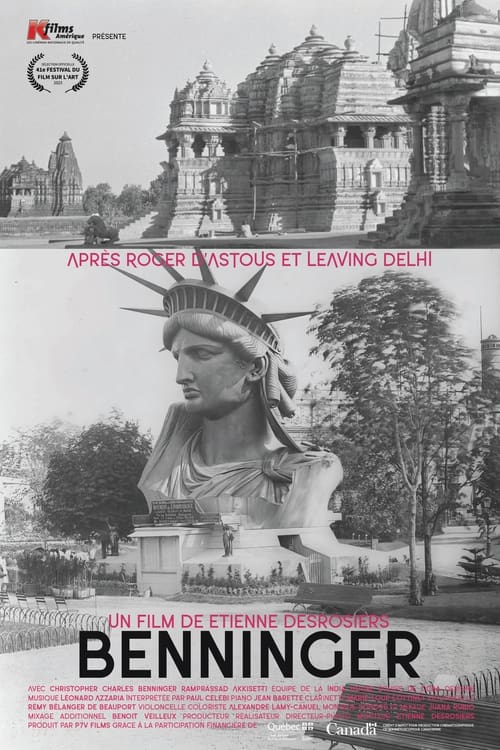
A documentary about Montreal architect Roger D'astous, who battled all his life to create a Nordic architecture. A star architect in the 60s, and Frank Lloyd Wright student, he fell from grace before rising again at the dawn of the century.
Roger D'Astous
as Self
Luc Durand
Serge Savard
Francine Grimaldi
Michel Catrice
Henri Brillon
Guy R. Legault
Yves Deschamps
France Vanlaethem
Famed Swiss architect and artist Robert Maillart was renowned for his concrete bridges; this documentary examines the elegant design of his engineering masterpieces, which, the film argues, embrace both functionality and aesthetics. Instead of following a traditional journalistic structure, director Heinz Emigholz's spellbinding film reads more like ethereal visual poetry, allowing the beauty of Maillart's work to speak for itself.
The Eames House and Studio is explored via a series of slides.
In 1935, Frank Lloyd Wright designed a country house for the Kaufmann family over a small stream in Western Pennsylvania. He named it Fallingwater. It, perhaps more than any other building, exemplifies Wright's concept of 'Organic Architecture,' which seeks to harmonize people and nature by integrating the building, the site, and its inhabitants into a unified whole. And today, the iconic image of the house over the waterfall, remains a testament to a great architect working at the height of his career. Highlights include interviews with Fallingwater director Lynda Waggoner and architectural historian Richard Cleary, who explain Wright's concept of "organic architecture" and the qualities that make the structure so exceptional.
Prestigious guitarist Stanley Jordan is well-known for his exclusive use of the guitar: His 10 fingers run along the neck of the instrument, creating special sound effects similar to those created by a keyboard. This video filmed at the XI Montreal International Jazz Festival presents Jordan's spectacular guitar solos, confirming his immense talent (as if any confirmation were necessary!).
The film juxtaposes/compares two museums: The Museum of Art, Ein Harod, Israel, which Samuel Bickels (1909-1975) built there in 1948, and The Menil Collection in Houston, Texas, built by Renzo Piano (b. 1937) 1986 . The method of natural lighting in Bickels‘s construction was the direct model for Piano, who adopted for his construction at the request of its patroness Dominique de Menil.
In 1914, the Czech architect Jan Letzel designed in the Japanese city of Hiroshima Center for the World Expo, which has turned into ruins after the atomic bombing in August 1945. “Atomic Dome” – all that remains of the destroyed palace of the exhibition – has become part of the Hiroshima memorial. In 2007, French sculptor, painter and film director Jean-Gabriel Périot assembled this cinematic collage from hundreds of multi-format, color and black and white photographs of different years’ of “Genbaku Dome”.
They come in high-powered convertibles, with cameras and curiosity, to look at French Canada and French-Canadians. Their usual objective is Québec City, where they can soak up a bit of French culture without a trip to France. With an eye for humour, VISIT TO A FOREIGN COUNTRY shows the people of Québec taking a look at American tourists who have come to Québec to take a look at them.
This feature film made during an exceptionally feverish period of popular revolt that saw the coming together of Quebec’s 3 main unions (CSN, FTQ, CEQ) is a cinematic tract by socially engaged filmmaker Gilles Groulx. Propped against the backdrop of the 1970 October Crisis, the film is a frontal assault denouncing a “consumer society” viewed as the ultimate embodiment of evil.
In this French Canadian film, the lives of teenagers are examined in fantasy sequences and through the use of documentary interviews. Prompted by the filmmaker, nine teenagers individually act out their secret dreams and, between times, talk about their world as they see it. The fantasy sequences make creative use of animation, unusual film-development techniques, and stills. Babette conceives of herself as an abbess defending her fortress, a convent; Michelle is transported in a dream of love where all time ceases; Philippe is the revolutionary, defeating all the institutions that plague him, and so on, through all their fantasies. All the actual preoccupations of youth are raised: authority, drugs, social conflict, sex. Jutra's style in "Wow" exhibits his innovative approach to storytelling and filmmaking, showcasing his talents as a director during that period. With English subtitles.
Chambord, the most impressive castle in the Loire Valley, in France, a truly Renaissance treasure, has always been an enigma to generations of historians. Why did King Francis I (1494-1547), who commissioned it, embark on this epic project in the heart of the marshlands in 1519? What significance did he want the castle to have? What role did his friend, Italian genius Leonardo Da Vinci (1452-1519) play? Was he the architect or who was?
Styles of architecture used in the 1951 South Bank Exhibition, London.
10 Buildings that Changed America presents 10 trend-setting works of architecture that have shaped and inspired our American landscape. These aren’t just historic structures by famous architects. These buildings have dramatically influenced our built environment in many ways – and in one case, for over two centuries.
The documentary rebuilds the life of the Brazilian architect João Batista Vilanova Artigas. His relatives, friends, students and six of his major works tell the history of this iconic Latin-American modernist.
Fleeing their war-torn homeland, forty thousand Algerians come to Montreal, Quebec in the 1990’s. Many are refused refugee status and are not allowed to study or work normally. Years go by, children are born and Canada becomes home. Then comes 911. Deportations begin.
A study of life at Christmastime in Moose Factory, an old settlement mainly composed of Cree families on the shore of James Bay, composed entirely of children's crayon drawings and narrated by children.