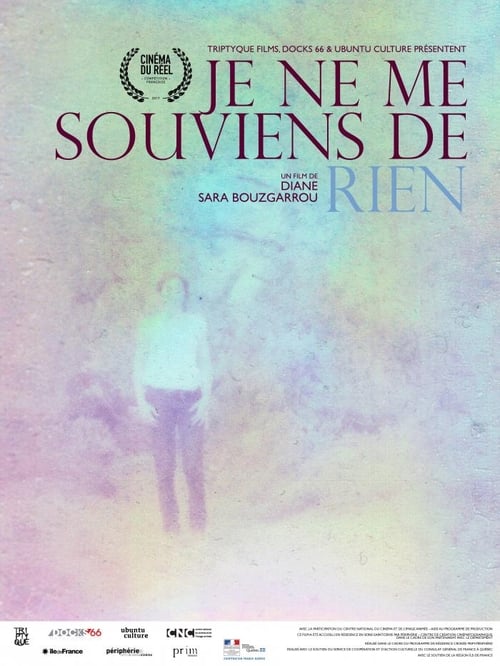
In the streets of Marseille, René Allio encounters, once again, the spaces of his childhood, and remembers his family history.
Paul Allio
as Self
René Allio
Pierre Allio
Isabelle Fenech
Jean Maurel
A community of cats lives in the Soledade Cemetery Park in Belém. "7 Vidas" follows these animals through a fictional letter written by one of them to his former owner. With real images of the cats among graves and trees, the film builds a sensitive narrative about abandonment, freedom and memory, revealing the poetry hidden in the coexistence between life and death.
Five Jewish Hungarians, now US citizens, tell their stories: before March 1944, when Nazis began to exterminate Hungarian Jews, months in concentration camps, and visiting childhood homes more than 50 years later. An historian, a Sonderkommando, a doctor who experimented on Auschwitz prisoners, and US soldiers who were part of the liberation in April 1945.
You might think that your memory is there to help you remember facts, such as birthdays or shopping lists. If so, you would be very wrong. The ability to travel back in time in your mind is, perhaps, your most remarkable ability, and develops over your lifespan. Horizon takes viewers on an extraordinary journey into the human memory. From the woman who is having her most traumatic memories wiped by a pill, to the man with no memory, this film reveals how these remarkable human stories are transforming our understanding of this unique human ability. The findings reveal the startling truth that everyone is little more than their own memory.
"Welcome to my life", Sylvie Hofmann repeats this sentence almost all day long. Sylvie has been a nurse for 40 years at the North Hospital of Marseille. Her life is running. Between patients, her sick mother, her husband and her daughter, she has always devoted her life to helping others. What if she decided to think a little about herself? To retire? Does she have the right, but above all, does she really want to?
Within the video, two screens coexist. On the primary screen, a repetitive action takes place - the photo in the hands is periodically blurred. The focus of the viewer's attention is shifted to the secondary screen, which is more dynamic. The face in front of the camera, resembling clay, tries to take on images from archival photographs and video recordings.
For DJs, life revolves around records. Around sounds. Every life is a story, every DJ is a narrator. Every stack of records is an endless collection of stories, myths, and memories. Can we know someone’s life through their records? For some, we can even know their impact.
Off the coast of Marseille, near a rocky cliff, a Greek ship was discovered at a depth of forty meters in Mediterranean waters, loaded with amphorae and other pottery. The cargo has been lying on that sandy stretch of seabed for more than two thousand years. The documentary follows the dives of divers who recover cups, vases, plates and jars still full of wine. We are also witnessing new recovery systems, with the use of compressed air.
Lara, a German au pair, recently arrived in Marseille, where a new life is beginning for her. Being an introverted young girl, she nevertheless throws herself into the unknown, into the twists and turns of a city whose codes she still does not know.
Staged as a series of voiceover sessions, written with gloriously off-balanced precision and dipped in the color green, THE FUTURE TENSE unfolds as a poignant tale of tales, exploring the filmmakers’ own experiences in aging, parenting, mental illness, along with the brutal history that lies submerged beneath Ireland’s heavy, moist earth.
Structured as a labyrinth-like game and inspired by Jorge Luis Borges, Aleph is a travelogue of experience, a dreamer's journey through the lives, experiences, stories and musings of protagonists spanning ten countries and five continents.
This film is a poetic composition of recorded history and non-recorded memory. Filmmaker Rea Tajiri’s family was among the 120,000 Japanese and Japanese Americans who were imprisoned in internment camps after the attack on Pearl Harbor. And like so many who were in the camps, Tajiri’s family wrapped their memories of that experience in a shroud of silence and forgetting. This film raises questions about collective history – questions that prompt Tajiri to daringly re-imagine and re-create what has been stolen and what has been lost.