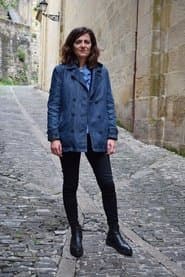
Through his own photographs, the Basque artist Néstor Basterretxea (1924-2014) is portrayed by the art critic and exhibition curator Peio Aguirre, a great connoisseur of his work and personal archives.
Maider Oleaga
as Self - Narrator (voice)
Tilly, Miah and Safa are three young women who endure debilitating period pain. Following an adolescence with little menstrual education, support or relief, they navigate the physical and emotional toll of intensely painful periods while trying to maintain a normal life.
Ra Paulette digs cathedral-like, 'eighth wonder of the world' art caves into the sandstone cliffs of Northern New Mexico. Each creation takes years to complete, and each is a masterwork. But patrons who have commissioned caves have cut off nearly all of his projects due to artistic differences. Fed up, Ra has chosen to forego all commissions to create his own Magnum Opus, a massive 10-year project.
The story of Alice Herz-Sommer, a German-speaking Jewish pianist from Prague who was, at her death, the world's oldest Holocaust survivor. She discusses the importance of music, laughter, and how to have an optimistic outlook on life.
An account of the life of actress Jeanne Moreau (1928-2017), a true icon of the New Wave and one of the most idolized French movie stars.
A cinematic essay interweaving private archive images and a mixture of reflective, speculative and poetic intertitles that, like “an old movie from the 20th century”, invites us to meditate on what Des Pallières once liked to call “our old homeland”.
Short documentary by Gaspar Noé filmed around the the same time as Irréversible (in 16mm Scope), in which his friend Stéphane Drouot, the director of the cult film "La Banlieue des Étoiles / Star Suburb", discusses his life with AIDS and struggles to make films.
A shortfilm directed for Canal + TV Show "L'Œil du Cyclone", Episode 74. "What interests me is the hypnotic trance in which one can plunge a viewer. When you make a film and it works, you're like a shaman, a hypnotist."
A joyful shot recorded by Weerasethakul himself and two young men who become acquainted by filming each other in the back of a moving pickup truck. Though seemingly playful, the short film is a subtle portrait of migrant workers in the north of Thailand.
Filmmaker Kogonada unpicks what defines the Golden Age of Italian cinema with a side-by-side comparison of two edits of the same film, one according to Italian director Vittorio De Sica, and the other according to Hollywood producer David O. Selznick.
The Text Allows No Interpretation is a personal essay documentary displaying the director’s conversation with his trauma in a stream of consciousness. The moments in photographs and videos are set in temporal disarray, meeting the superimposed phone calls speaking to and around the trauma from the past. The ever-present noise of repetition is created through jumps between memories of fear and death during the decade-old Arab Spring to insomnia and anxiety emerging through the footage of NATO military exercises on the borders of Russia.
On March 30, 2022, Barcelona and Real Madrid's rivalry was at the forefront of football. But this time, it was the women's teams who were centre stage as they played out a seven-goal thriller in front of a world record crowd of 91,553 fans.
Documentary of the Rustavi Metal Works, in the country of Georgia.
Part of a series in which foreign filmmakers portray a region or town in France. Otar Iosselani looks at the Basque region and its inhabitants.
A film about the consequences of leaving an all-consuming way of life. Three people born and raised in the Unification Church (a cult formed in Korea in the 1950s), all having left the Church in their adulthood, examine their experiences within and without the cult that defined their entire universe.
An account of the life and work of French filmmaker Claude Chabrol (1930-2010), a sybarite Buddha, a furtive anarchist, an insolent lover of life.
A hole gapes in a house wall. A small flaw, something imperfect that we seldom consciously direct our attention to. Filmmaker Ondřej Vavrečka finds holes in every corner. His focus is on the imperfections of human existence. A hole can also mean an uncertain future, or an empty stomach. The gap that partners leave behind after a breakup. Ondřej Vavrečka does not only deal with visible holes. He looks at the incomplete from a philosophical perspective. He also lets a nuclear physicist, a theologian and an ethnologist have their say. He underscores their thoughts and theses with absurd everyday scenes: a woman with a chair on her head or an invisible skier. These scenes combine with interviews, sounds and stop-motion sequences to create a playful collage.
Martin Short narrates the story of "his own" birth to explain the subjects of sex, conception, pregnancy and childbirth in an entertaining and educational way.