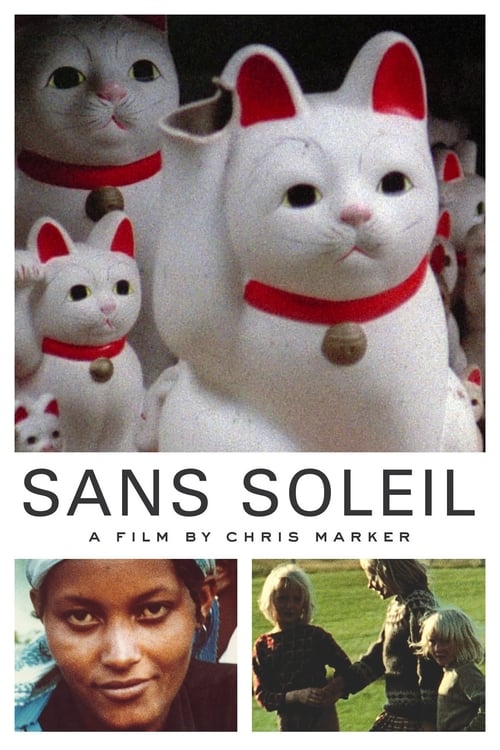
Inspired by Chris Marker's Sans Soleil, a girl decides to make her own rendition of Marker's mesmerising voyage through Japan, only for it to turn awry when she encounters another girl - a recurring stranger - haunting her path.
Matilda Chua
as Narrator
In the aftermath of a car crash, a man discovers his dreams are tied to a stranger's sleepwalking.
Sports enthusiast Ernest is to cover 6,000 kilometers on his motorcycle in 15 days, crossing Austria, Italy, Switzerland, the Balkans and Czechoslovakia.
Amidst a series of female kidnappings, Samantha has a date with a mysterious man she knows very little about.
Haunting colour travelogue taking in Ulster, Lewis, Lincoln and Cardiff's Tiger Bay.
Spalding Gray sits behind a desk throughout the entire film and recounts his exploits and chance encounters while playing a minor role in the film 'The Killing Fields'. At the same time, he gives a background to the events occurring in Cambodia at the time the film was set.
The homeless, underground residents at a post-communist train station and their intimate confessions. A film not about misery, but the lust for life and color even at the depths of human despair.
This Traveltalk series short visits Hungary's capital, Budapest.
A woman narrates the thoughts of a world traveler, meditations on time and memory expressed in words and images from places as far-flung as Japan, Guinea-Bissau, Iceland, and San Francisco.
Bruce Brown's The Endless Summer is one of the first and most influential surf movies of all time. The film documents American surfers Mike Hynson and Robert August as they travel the world during California’s winter (which, back in 1965 was off-season for surfing) in search of the perfect wave and ultimately, an endless summer.
Travel films have an established format with their own conventions, history and baggage. It is a medium that has all too often sought to control, define and dictate perceptions of ”other” places. Comprised of footage shot while travelling on group excursions across Russia in 2019, An Uncountable Number of Threads is an attempt to draw out the ethical restrictions of a travelogue, while questioning how (and why) to make one. At times there is an awkward tourist-gaze, aware of its outsider position. But as a self-reflexive work that considers its own creation, it ultimately unravels, as the artist rationalises themselves out of a particular way of working, inviting the viewer into their uncertainty.
After his colleague Schweitzer goes missing during a drug raid, undercover cop Till Hager is tasked with tracking down a mysterious new drug called "Abaddon" - a substance which supposedly drags it's users down the deepest depths of hell.
A fearless horse bonds two men to each other and to the traditions that define their community.
In 1962 Joris Ivens was invited to Chile for teaching and filmmaking. Together with students he made …A Valparaíso, one of his most poetic films. Contrasting the prestigious history of the seaport with the present the film sketches a portrait of the city, built on 42 hills, with its wealth and poverty, its daily life on the streets, the stairs, the rack railways and in the bars. Although the port has lost its importance, the rich past is still present in the impoverished city. The film echoes this ambiguous situation in its dialectical poetic style, interweaving the daily life reality (of 1963) with the history of the city and changing from black and white to colour, finally leaving us with hopeful perspective for the children who are playing on the stairs and hills of this beautiful town.
This Screenliner short looks at the dress and customs of Nazaré, a fishing village on Portugal's Atlantic coast.
Documentary about the photo session for the photobook "Castella", filmed in Portugal.
In 1899, a photographer at American Mutoscope & Biograph mounted his camera on the front of a trolley traveling over the Brooklyn Bridge. The three 90-foot rolls he created were edited together to complete the journey from Manhattan to Brooklyn, entitled Across the Brooklyn Bridge. As a commission by the Museum of Modern Art for the re-opening of their facility, American avant-garde filmmaker Bill Morrison took this remarkable footage and recombined it with itself to form a new split-screen extrapolation.
The film is a travelogue of sorts. Ostrovsky’s personal family footage meets the archives of Soviet propaganda footage. The result is a kind of Khruschev-era mix with a collage of Soviet music and a voice-over of my reminiscences of the Cold War era.
A travelogue about India. But it is more than a video about a foreign place. We follow the director's itinerary and witness his chance encounters with people and also public events, some of which continue to shape India's politics today.